
Your investing time horizon is how long you have before you need the money. It can be months, years, or decades.
Time horizon matters because investments can drop in value. The less time you have, the less room you have to recover.
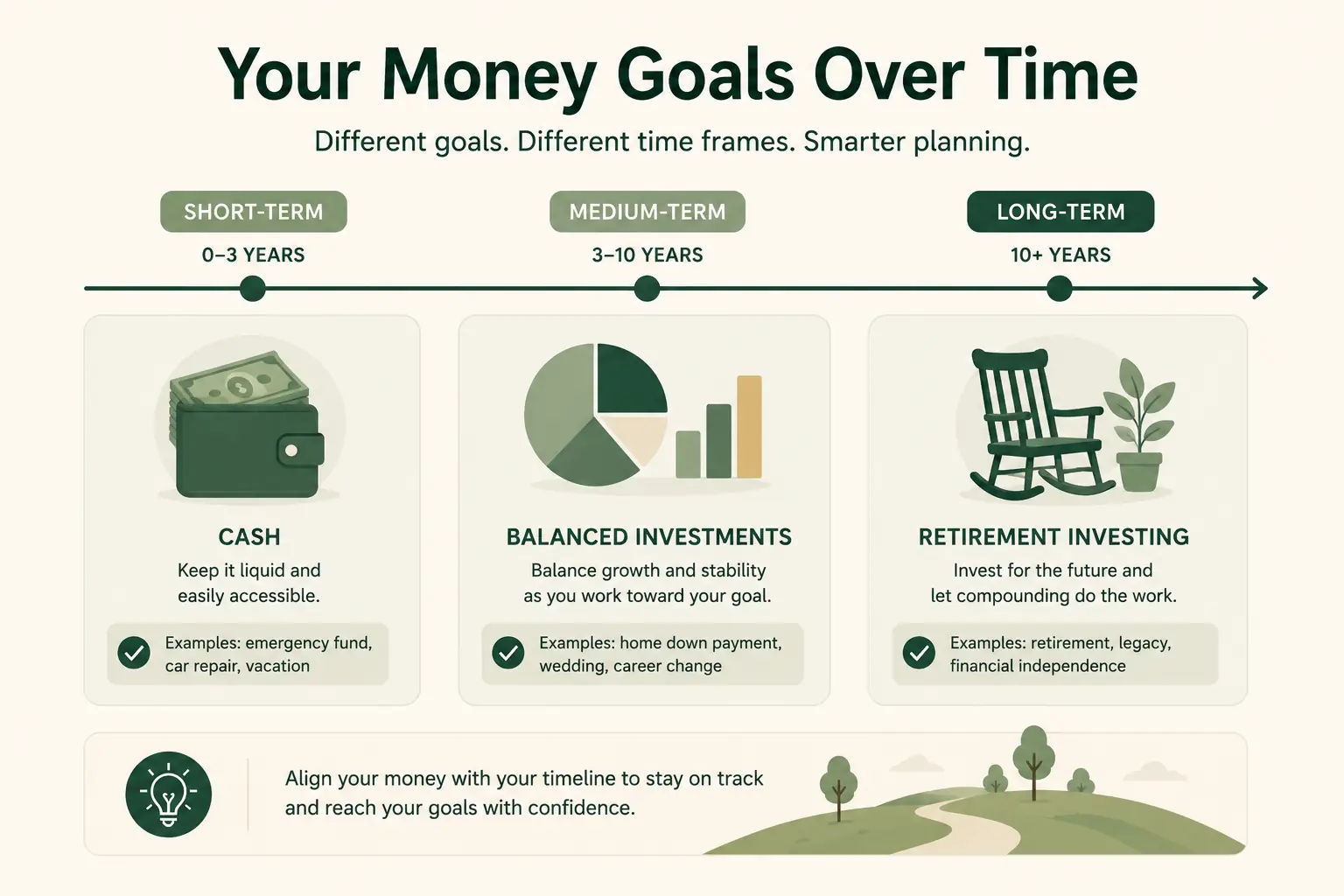
Short-Term Money
Money needed in the next few months or years usually doesn’t belong in risky investments.
Examples:
- Rent and monthly expenses
- Emergency savings
- Moving costs
- Car purchase money
- Tuition due soon
- A home down payment needed soon
For short-term goals, stability matters more than growth. A stock market drop of 30% right before you need the money could force you to sell at a loss, or leave you short when the deadline arrives. Short-term money typically belongs in FDIC-insured savings accounts, high-yield savings accounts, or money market accounts, not in the stock market.
Medium-Term Money
Medium-term goals are harder. You may have enough time to earn some return, but not enough time to ignore a big market drop.
Examples:
- A home purchase in five years
- Starting a business
- Planned career break
- Future education costs
The right mix depends on flexibility. If the date can move, you can accept more risk. If the date is fixed, be more careful. A common approach for medium-term goals is a conservative mix, mostly stable assets with a smaller slice in stocks, so you’re not missing out on all growth but you’re also not fully exposed to market swings.
Long-Term Money
Long-term money may have decades to grow. Retirement savings for a young worker is the clearest example.
Longer time horizons make stocks and diversified stock funds more practical because you have more time to recover from declines. Historically, broadly diversified stock portfolios have recovered from every major downturn, though past history doesn’t guarantee future results, and recovery timelines have varied widely.
That doesn’t mean long-term investing is risk-free. It means the risk can be more manageable if your plan is diversified and you can stay invested. The key advantage of a long time horizon is that you don’t have to sell during a downturn; you can wait. To understand the risk types involved, see What Is Investment Risk?.
Time Horizon By Goal Type
| Goal | Typical Horizon | Suggested Approach |
|---|---|---|
| Emergency fund | Immediate access needed | High-yield savings, money market |
| Vacation next year | Under 1 year | Savings account |
| Car in 2–3 years | Short-term | Savings or conservative allocation |
| House down payment in 5 years | Medium-term | Conservative mix; mostly stable assets |
| Child’s education in 10+ years | Medium-to-long | Moderate stock/bond mix |
| Retirement in 30+ years | Long-term | Higher stock allocation, diversified funds |
Match The Account To The Goal
Ask:
- When will I need this money?
- Is the date flexible?
- What happens if the value drops right before I need it?
- Do I have emergency savings elsewhere?
- Can I emotionally handle the ups and downs?
If the money has a short deadline, the answer may be savings, not investing. Even if you want to grow the money, putting it at risk of a 30% drop right when you need it isn’t a good trade.
Understanding how compound interest works helps explain why starting early matters, the sooner money starts growing, the more compounding helps, and the better your long-term outcome tends to be.
The Emotional Component
Time horizon isn’t just math. It also involves how you’ll actually behave when markets drop.
If you’re saving for retirement 30 years away but you panic-sell every time the market falls 15%, your practical time horizon is much shorter than your theoretical one. A plan that looks right on paper but is impossible to stick with isn’t actually a good plan.
This is why financial educators often suggest starting with a simple, diversified fund you can hold without making changes during market swings, rather than a more complex approach that requires active management. Opening a brokerage account and choosing a broad index fund is usually the simplest starting point.
Frequently Asked Questions
Q: Should my time horizon change as I get older?
Yes. As you get closer to needing the money, your time horizon shortens and you generally want to shift toward less volatile, more stable investments. This is the logic behind “target-date funds” in retirement accounts; they automatically adjust their stock and bond mix to become more conservative as your retirement year approaches.
Q: I’m in my 20s, does that mean I should put everything in stocks?
A high stock allocation often makes sense for very long-term money like retirement savings, but not for all your money. Your emergency fund, short-term goals, and anything you might need within a few years should stay out of the stock market. The time horizon rule applies to each goal separately, not to all your money as one big pool.
Q: What if I start investing late and have a shorter horizon than I’d like?
A shorter time horizon simply means taking less risk with that money. You may not be able to use the same stock-heavy allocation as someone with 30 years to go, but you can still invest more conservatively, a mix of bonds and stocks suited to a 10- or 15-year horizon can still compound meaningfully. Starting late is better than not starting. And paying off high-interest debt is just as important. See How Compound Interest Works for why every year still matters.
Q: Can the same money have multiple time horizons?
Not exactly, each dollar has one real timeline. But you can split your savings into buckets by goal. Emergency money goes in a savings account. Money for a house in five years gets a conservative allocation. Money for retirement gets a long-horizon allocation. This “bucket” approach helps you avoid treating short-term money the same as long-term money.
Learn More
- Investor.gov: Time Horizon
- Investor.gov: Gauge Your Risk Tolerance
- SEC: Building long-term savings