
Investment risk is the chance that an investment doesn’t do what you hoped. That can mean losing money, earning less than expected, or needing cash when the investment is temporarily down.
Risk isn’t always bad. Taking some risk is generally part of long-term growth. The problem is taking risk you don’t understand or can’t afford.
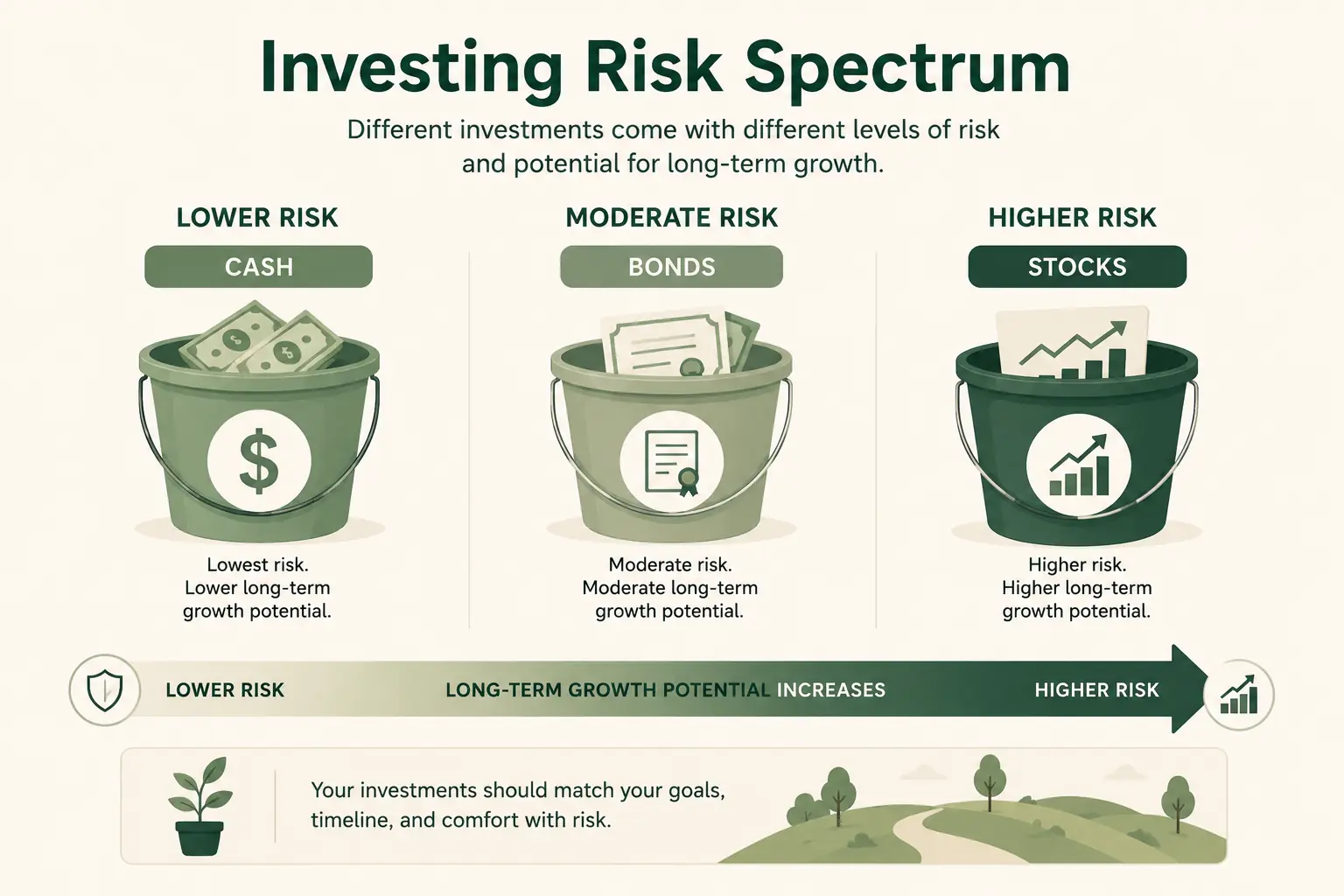
Market Risk
Market risk is the chance that investment prices fall because the overall market falls. Stocks, stock funds, bond funds, and other investments can all lose value.
Even diversified funds can drop when the broader market drops. During the 2008 financial crisis, broadly diversified U.S. stock funds fell roughly 50%. During the 2020 COVID crash, markets fell about 34% in a matter of weeks before recovering. Neither event was predictable in advance. This is why your timeline matters: you can only recover from a market drop if you don’t have to sell during it.
Inflation Risk
Inflation risk is the chance that your money loses buying power over time. Cash can feel safe because the dollar amount doesn’t change, but prices can rise.
For short-term goals, cash may still be appropriate. For long-term goals, keeping everything in cash creates its own risk. If inflation averages 3% per year and your savings account earns 1%, you’re losing ground every year in real terms, even if the dollar balance is growing.
This is why long-term investors often accept some market risk: the historical return from diversified stocks has outpaced inflation over most long periods, even with the bad years included.
Concentration Risk
Concentration risk happens when too much of your money depends on one company, one industry, one country, or one idea.
Owning one stock is usually riskier than owning a broad fund. If that company struggles, your money is hit directly. Employees who hold a lot of their employer’s stock face this risk sharply: if the company fails, they can lose both their job and their savings at once.
Even a “diversified” portfolio can have hidden concentration. A technology-heavy fund may spread across 50 companies, but if all of those companies fall together when the tech sector has a bad year, the diversification offers less protection than it appears.
Liquidity Risk
Liquidity risk is the chance that you can’t sell an investment quickly at a fair price. This matters most if you might need the money soon.
Most stocks and ETFs traded on major exchanges are highly liquid: you can sell quickly without taking a bad price. But some investments are much harder to exit: real estate, private equity, some bond types, and certain niche ETFs with low trading volume can all become difficult to sell at the wrong moment.
Your emergency fund should stay out of investments with meaningful liquidity risk. For short-term cash needs, a high-yield savings account is usually the right place.
Timeline Changes Risk
The same investment can be reasonable for one goal and wrong for another.
Money needed in six months should generally be handled carefully. Money for retirement in 30 years may have much more time to recover from market drops.
Your timeline, also called your time horizon, is one of the biggest factors in how much risk makes sense. Understanding your investing time horizon is essential before choosing any investment. A 25-year-old can typically tolerate more short-term volatility in their retirement account than a 60-year-old planning to retire in two years.
Risk Tolerance Is Personal
Risk tolerance is your ability and willingness to handle losses. Some people can watch an account drop and stay calm. Others panic and sell at the worst time.
Both are normal responses. The difference in outcome can be enormous: selling during a crash locks in your losses, while staying invested lets you recover. A plan you can’t stick with may be too risky, even if it looks good on paper.
There’s also a difference between your financial risk tolerance (can you actually afford a loss?) and your emotional risk tolerance (can you stomach watching the balance drop?). Both matter.
Types Of Risk At A Glance
| Risk Type | What It Means | Who It Affects Most |
|---|---|---|
| Market risk | Prices fall because the overall market falls | Anyone invested in stocks or funds |
| Inflation risk | Purchasing power shrinks over time | People keeping too much in cash long-term |
| Concentration risk | Too much depends on one thing | Single-stock holders, sector bets |
| Liquidity risk | Can’t sell at a fair price quickly | Short-term needs met with illiquid assets |
| Credit risk | Issuer may not repay (bonds) | Bond investors, especially high-yield |
| Timing risk | Needing money when values are down | Anyone with a fixed deadline |
Frequently Asked Questions
Q: Is there such a thing as a risk-free investment?
Not really. Cash loses purchasing power to inflation. U.S. Treasury bonds are considered very low default risk, but they still carry interest rate and inflation risk. FDIC-insured savings accounts protect your dollar amount up to the FDIC limit but don’t grow meaningfully above inflation. Every option involves a tradeoff.
Q: How do I reduce investment risk?
The most practical tools are diversification (spread across many investments), matching your investments to your timeline, keeping costs low, and having an emergency fund so you don’t have to sell investments during a downturn. See What Is An Index Fund? for how broad diversification through funds works.
Q: How much risk should a beginner take?
It depends on when you need the money. Money you need in under two years generally shouldn’t be in stocks. Money you won’t need for 10+ years can usually handle more stock exposure. A common starting point for young people saving for retirement is a high stock allocation, like 80 to 90%, with the rest in bonds, gradually shifting more conservative over time.
Q: What’s the difference between risk and volatility?
Volatility is how much an investment’s price moves up and down. Risk is the chance of actual loss or failing to meet your goal. High volatility can become high risk if you need the money soon or sell at the wrong time. For a long-term investor who stays the course, volatility is less threatening than it feels.
Learn More
- Investor.gov: What is Risk?
- Investor.gov: Asset Allocation and Diversification
- SEC.gov: Invest Wisely, An Introduction to Mutual Funds