
Compound interest means earning interest on interest you’ve already earned. Over long periods, this makes an enormous difference. Over short periods, it barely shows. That gap explains why time is one of the most important factors in any savings or investment plan.
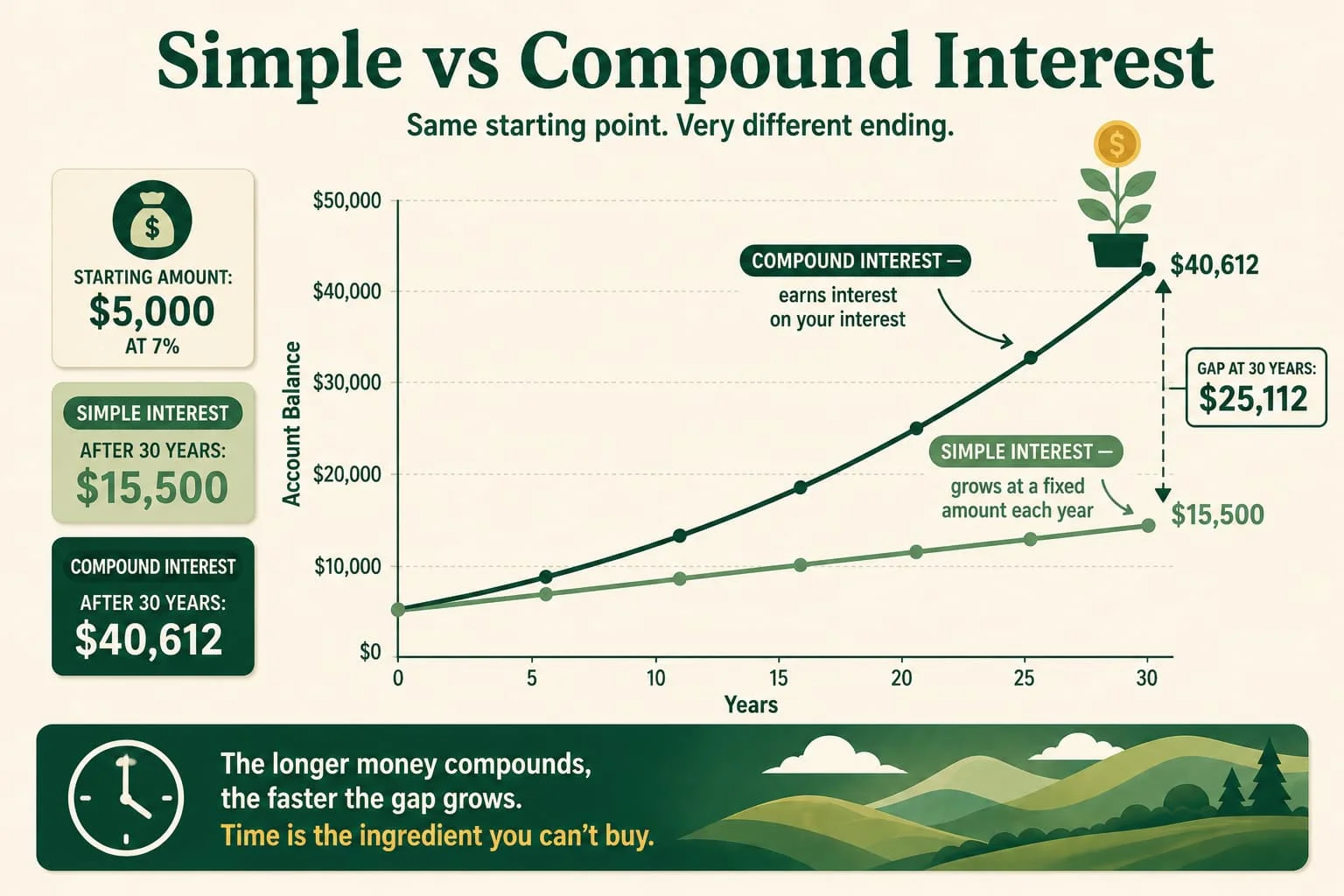
Simple Interest vs Compound Interest
With simple interest, you earn a fixed amount on your original deposit every year. The balance grows, but at a steady, predictable pace.
With compound interest, the interest you earn gets added to your balance. Then next year, you earn interest on the larger balance, not just the original amount. The growth feeds itself.
Example: You put $1,000 in an account earning 5% per year.
With simple interest:
- Year 1: $1,000 × 5% = $50 interest → balance $1,050
- Year 2: $1,000 × 5% = $50 interest → balance $1,100
- Year 10: balance $1,500
With compound interest (annual compounding):
- Year 1: $1,000 × 5% = $50 interest → balance $1,050
- Year 2: $1,050 × 5% = $52.50 interest → balance $1,102.50
- Year 10: balance approximately $1,629
That difference grows larger the longer the money stays invested. In year 10, it is modest. In year 30, it is dramatic.
How Compounding Frequency Affects Growth
Interest can compound annually, monthly, daily, or at other intervals. More frequent compounding means the interest-on-interest cycle repeats faster.
For most savings accounts and investments, the difference between monthly and daily compounding is small in practice. What matters much more is the rate and how long the money stays invested.
Banks often advertise APY (Annual Percentage Yield) rather than a simple interest rate. APY already accounts for the effect of compounding within the year, making it a more accurate picture of what you’ll actually earn. See What Is APR? for how lenders use a similar concept on the borrowing side.
Why Time Matters More Than Amount
The math behind compounding rewards time heavily. More heavily than most people expect.
Two people both invest in a retirement account:
- Person A starts at 25, contributes for 10 years, then stops completely. Total contributed: $30,000.
- Person B waits until 35, then contributes the same amount every year for 30 years. Total contributed: $90,000.
At a consistent return rate, Person A, who contributed far less, can still end up with more money at retirement than Person B. The reason: money invested early has decades more time to earn returns on returns.
This is also why your investing time horizon is such a critical concept. The longer the time horizon, the more compounding can do the heavy lifting for you.
The Rule of 72
The Rule of 72 is a quick estimate for how long it takes money to roughly double.
Divide 72 by the annual interest rate:
- At 6% per year: 72 ÷ 6 = about 12 years to double
- At 4% per year: 72 ÷ 4 = about 18 years to double
- At 9% per year: 72 ÷ 9 = about 8 years to double
This is an approximation, not a guarantee. Investment returns aren’t fixed, and past rates don’t predict future ones. But it’s a useful mental shortcut for understanding how different return rates translate to real outcomes.
Compounding Works Against You With Debt
The same math that grows savings also grows debt.
Credit card balances, unpaid loans, and other high-interest debt compound the same way. If you carry a balance at a high APR, the balance can grow quickly even if you stop spending. See How To Pay Off Credit Card Debt if you’re dealing with this now.
Paying off high-interest debt before investing more aggressively can be the highest guaranteed return you’ll find. If your credit card charges 22% APR, every dollar you put toward that debt effectively earns you a guaranteed 22% return, something no investment reliably matches.
Fees And Compound Interest Work In Reverse
Compound interest also works against you through fees. A fund that charges 1% per year doesn’t just cost you 1% once. It costs you 1% every year, on a growing balance.
Over 30 years, the difference between a 0.05% expense ratio fund and a 1.00% expense ratio fund can cost you tens of thousands of dollars on a modest portfolio. The money you didn’t pay in fees would have compounded too.
This is why keeping investment costs low matters so much for long-term results. See What Is An Index Fund? for how low-cost funds harness this advantage.
What This Means Practically
- Starting earlier usually matters more than starting with a larger amount.
- Adding money consistently, even in small amounts, still benefits from compounding over time.
- High fees or high-interest debt can cancel out compounding gains.
- Withdrawing savings early interrupts compounding and may reduce long-term growth significantly.
Compound interest doesn’t make risky investments safe, and returns aren’t guaranteed. But time in the market is one of the factors you can actually control, and that’s worth a lot.
Compound Interest At A Glance
| Scenario | What Compounds | Effect On You |
|---|---|---|
| Savings account or investment | Returns on your balance | Grows your wealth over time |
| Credit card debt | Interest on your unpaid balance | Grows your debt over time |
| Investment fees | Costs applied to growing balance | Slowly erodes long-term returns |
| Regular contributions | Each deposit starts its own compounding | Supercharges growth vs lump sum |
Frequently Asked Questions
Q: Does compound interest really make that big a difference?
Yes, but mainly over long periods. In the first few years, the difference between simple and compound interest looks small. Over 20 to 30 years, the gap becomes enormous. Starting in your 20s, even with a small amount, can produce better retirement outcomes than waiting until your 30s or 40s and contributing much more.
Q: How do I take advantage of compound interest?
Start as early as you can. Invest consistently rather than waiting for the “perfect time.” Keep costs low. And don’t withdraw early: every withdrawal resets that money’s compounding clock to zero. Using tax-advantaged accounts like a Roth IRA or 401k lets the compounding happen without annual tax drag, which amplifies the effect further.
Q: Is compounding the same as investing?
Not exactly. Compound interest is a math concept, what happens when returns earn returns. Investing is putting money into assets that can grow. Most investments benefit from compounding when you reinvest dividends and gains, but the returns aren’t guaranteed the way a savings account rate is. The principle applies to both, but with very different levels of certainty.
Q: Does compound interest work differently in a savings account vs the stock market?
The mechanism is the same: returns build on previous returns. The difference is predictability. A savings account earns a stated rate consistently. The stock market fluctuates: some years add a lot, some years subtract, and you can’t predict the sequence. Over long periods, both benefit from compounding, but stock market compounding involves significantly more short-term volatility.
Learn More
- Investor.gov: Compound interest calculator
- Consumer Financial Protection Bureau: How does interest work?
- SEC: Why saving early matters