
Traditional IRAs and Roth IRAs are both individual retirement accounts. The big difference is when the tax benefit shows up.
With a traditional IRA, the possible benefit is often upfront. With a Roth IRA, the possible benefit comes later.
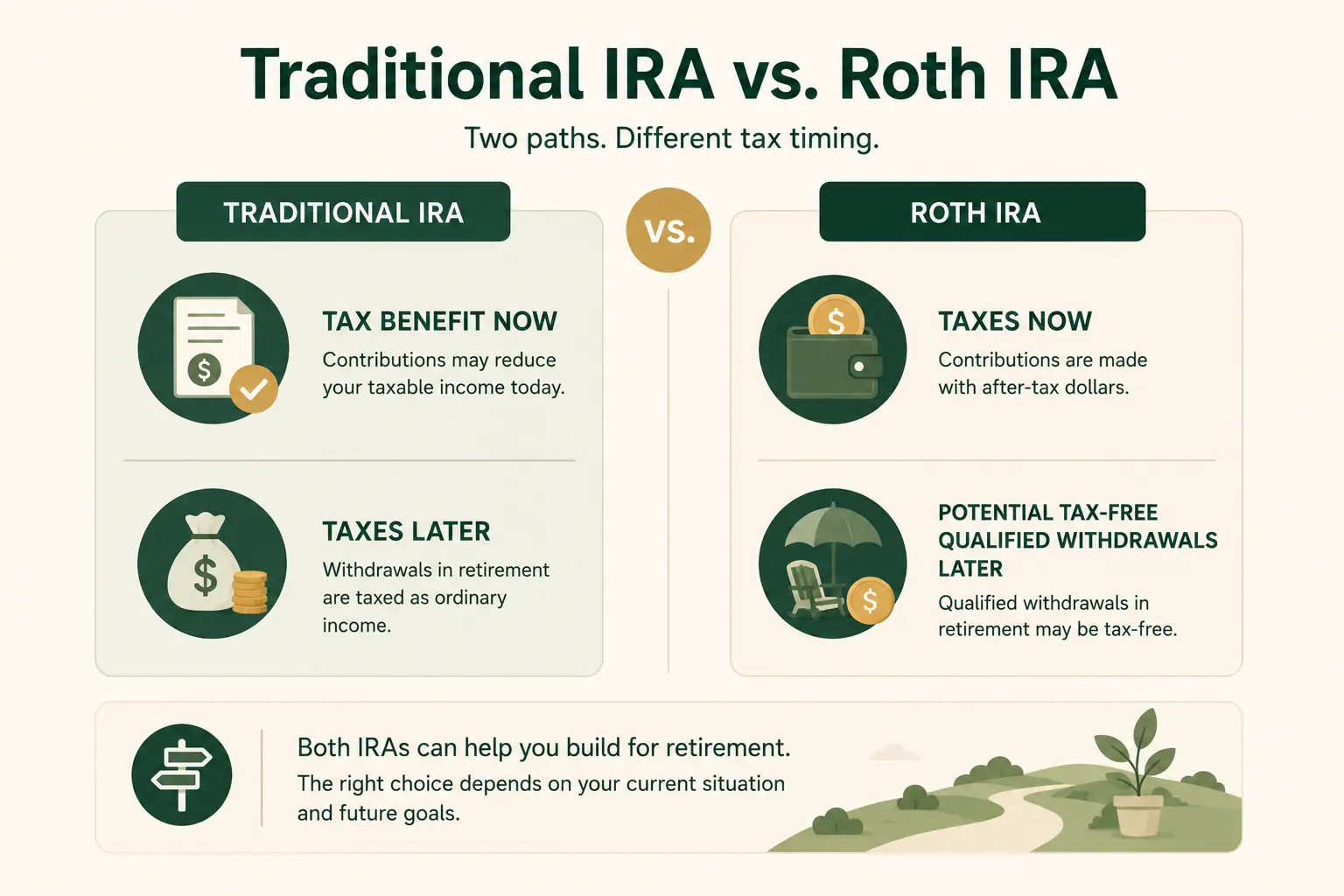
Traditional IRA Basics
Traditional IRA contributions may be fully or partially deductible, depending on your income, filing status, and whether you or your spouse are covered by a workplace retirement plan like a 401k or 403b.
When contributions are deductible, you reduce your taxable income for that year. For example, if you earn $55,000 and contribute $5,000 to a deductible traditional IRA, you are taxed on only $50,000 that year.
Money in the account grows tax-deferred: you do not pay taxes on dividends, interest, or capital gains each year while the money is inside the IRA. Withdrawals in retirement are taxable as ordinary income.
Once you reach a certain age, the IRS requires you to take out a minimum amount each year. These are called required minimum distributions, or RMDs. Missing them triggers a significant penalty.
Roth IRA Basics
Roth IRA contributions come from money you have already paid tax on. They do not lower your taxable income now.
The payoff is that qualified withdrawals later can be tax-free, including all the investment growth built up over your working years. That tax-free compounding can be especially powerful over long time horizons.
Roth IRA eligibility depends on income, and the rules can change, so check IRS.gov before contributing. There are income ranges above which you cannot contribute directly to a Roth IRA. Roth IRAs also have no required minimum distributions during your lifetime, which gives you more flexibility for estate planning or simply letting the money grow longer.
For more detail on the Roth IRA, see What Is A Roth IRA?
Side-By-Side Comparison
| Feature | Traditional IRA | Roth IRA |
|---|---|---|
| Contributions | Pre-tax (if deductible) or after-tax | After-tax only |
| Tax deduction now | Yes, if you qualify | No |
| Tax on withdrawals | Taxable as ordinary income | Tax-free if qualified |
| Income limit to contribute | No (but deductibility has limits) | Yes, phases out at higher incomes |
| Early withdrawal of contributions | Generally taxable + 10% penalty | Contributions only: penalty-free anytime |
| Required minimum distributions | Yes, starting at a set age | No (during owner’s lifetime) |
| Best if… | You expect lower taxes in retirement | You expect higher taxes in retirement |
Taxes Now vs Taxes Later
The choice usually comes down to tax timing.
A traditional IRA may make more sense if a deduction helps you now and you expect lower taxes in retirement. This is common for people in their peak earning years who expect to spend less later.
A Roth IRA may make more sense if you expect higher taxes later, want tax-free qualified withdrawals, or want more flexibility. Younger workers early in their careers often fit here. They’re paying a lower tax rate now than they expect to pay at peak earnings.
Nobody knows future tax rates for certain, so this is always an educated guess. Some people contribute to both over the years to hedge against the uncertainty. Others split contributions between a traditional 401k at work and a Roth IRA to spread their tax exposure across both strategies.
Do Not Forget The Investment Step
Opening an IRA is not the same as investing. After money goes into the account, you need to choose what to invest in.
If the money sits in cash by accident, it will not grow the way you expected. This is one of the most common mistakes with new IRA accounts, people assume depositing funds means they are invested, but the account may default to a low-interest cash position until you pick funds or stocks. Understanding how compound interest works shows why getting money invested early, even in a simple index fund, matters more than finding the perfect fund later.
Watch The Rules
Watch out for:
- Contribution limits, the IRS sets a combined annual limit across all your IRAs (traditional + Roth together), not per account
- Income limits, for Roth contributions, and for whether traditional contributions are deductible
- Deduction rules, having a workplace retirement plan may reduce or cut the traditional IRA deduction
- Early withdrawal rules, taking money out before age 59½ can trigger taxes and a 10% penalty (with some exceptions)
- Required minimum distributions, traditional IRAs require withdrawals starting at a certain age; Roth IRAs do not during your lifetime
- Earned income, you must have wages or self-employment income to contribute to either type of IRA
IRA rules are detailed, and mistakes can cost you in taxes or penalties. Check IRS.gov each year since limits and phase-out ranges are adjusted regularly.
Frequently Asked Questions
Q: Should I open a traditional IRA or a Roth IRA?
It depends mainly on whether you expect your tax rate to be higher now or in retirement. If you are in a low tax bracket now (common early in a career), many people prefer the Roth, paying tax now at a lower rate in exchange for tax-free withdrawals later. If you are in a high tax bracket now and expect lower income in retirement, the traditional IRA’s upfront deduction may be more valuable.
Q: Can I contribute to both a traditional IRA and a Roth IRA in the same year?
Yes, but the IRS contribution limit applies to your total IRA contributions across both accounts combined. You cannot double the limit by splitting between the two; you are dividing one limit between them.
Q: What if I contribute to a Roth IRA but my income turns out to be too high?
This is called an excess contribution and it carries a 6% annual penalty until corrected. You can fix it by withdrawing the excess (and any earnings on it) before the tax filing deadline. If you are not sure whether your income will stay within the limit, consider waiting until your income is clear before contributing, or consult a tax professional.
Q: Can I convert a traditional IRA to a Roth IRA?
Yes. This is called a Roth conversion. You move money from a traditional IRA into a Roth IRA and pay income tax on the converted amount in that year. It can make sense if you have a lower-income year, or if you want to move more money into a Roth structure over time. A large conversion can push you into a higher tax bracket for that year, so plan carefully.
Learn More
- IRS: Traditional IRAs
- IRS: Roth IRAs
- IRS: IRA-based plans
- IRS: IRA contribution limits