
A tax bracket is a range of income taxed at a specific rate. The United States uses a progressive tax system, higher income is taxed at higher rates, but only the income within each bracket, not all of your income.
This matters because one of the most common tax misconceptions is that a raise can leave you with less take-home pay. That’s not how the system works.
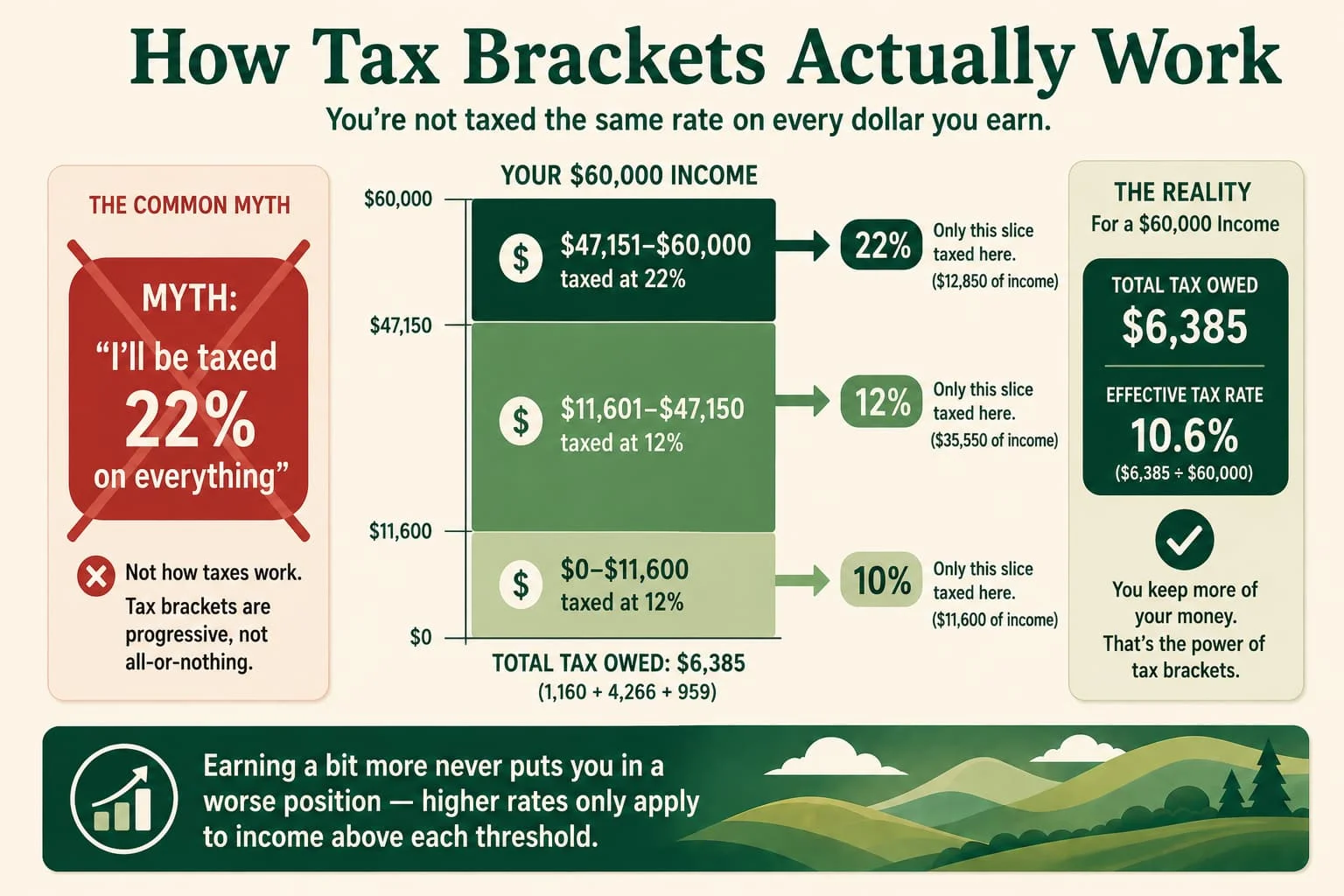
How Brackets Actually Work
Tax brackets apply in layers, not all at once.
Imagine three brackets in a simplified example:
- Income from $0 to $11,000: taxed at 10%
- Income from $11,001 to $44,000: taxed at 12%
- Income from $44,001 to $95,000: taxed at 22%
If you earn $50,000:
- The first $11,000 is taxed at 10% = $1,100
- The next $33,000 (from $11,001 to $44,000) is taxed at 12% = $3,960
- The remaining $6,000 (from $44,001 to $50,000) is taxed at 22% = $1,320
- Total federal income tax: about $6,380
Your marginal tax rate is 22%, because that’s the rate on your last dollar earned. Your effective tax rate, the percentage of your total income that went to taxes, is lower, around 12.8% in this example.
Only the income above each threshold is taxed at the higher rate. Everything below it is still taxed at the lower rates.
Why A Raise Does Not Cost You Money
If a raise pushes you into the next bracket, only the dollars above the threshold are taxed at the higher rate. The dollars below it are still taxed at the same rates as before.
A raise from $44,000 to $50,000 doesn’t mean all $50,000 gets taxed at the higher rate. Only the $6,000 above the threshold gets the higher rate.
A raise always increases your take-home pay, even if it crosses a bracket line. You will never bring home less money because you earned more.
Marginal Rate vs Effective Rate
Marginal rate: The rate on your highest dollar of income, the bracket you’re “in.” This is the most useful number when thinking about the tax cost of a deduction, a bonus, or side income.
Effective rate: The actual percentage of your total income that went to federal income tax. It’s almost always lower than the marginal rate because the lower brackets apply to the earlier portions of income.
When comparing job offers or thinking about side income, your marginal rate is the more useful number. It tells you how much of the next dollar you earn you actually keep after federal income tax. See Are Side Gigs Worth It? for how this applies to extra income.
For more context on how your full paycheck breaks down, see Gross Pay vs Take-Home Pay.
What Reduces Taxable Income
Your full gross income usually isn’t what gets taxed. The standard deduction reduces your taxable income before brackets apply, which means many people pay taxes on much less than they actually earned.
For example, the 2026 standard deduction is $16,100 for a single filer. If you earn $50,000, only about $33,900 of income is taxable. That can push you into a lower effective bracket range than your gross income suggests.
Other things that can reduce your taxable income:
- Contributions to a traditional 401k or traditional IRA
- Student loan interest (subject to income limits and phase-outs)
- Contributions to a Health Savings Account (HSA)
- Business expenses if you’re self-employed
- Certain itemized deductions if they exceed the standard deduction
The details depend on your situation and current tax law. Tax rules change, so check IRS.gov or ask a tax professional to confirm the specifics for your situation.
If you are deciding which deduction path applies when you file, see Standard Deduction vs Itemized Deduction.
How Your W-4 Connects To Brackets
Your employer uses the W-4 form you fill out to estimate how much federal income tax to withhold from each paycheck. Getting this right means you don’t owe a big lump sum at tax time, and you don’t overpay throughout the year.
Brackets Change Over Time
The IRS adjusts tax brackets for inflation each year. The exact rates and thresholds depend on the tax year you’re filing for.
Always check IRS.gov for the current year’s brackets before doing any planning. Don’t rely on numbers from a previous year.
State Taxes Are Separate
Federal brackets are one part of the picture. Many states have their own income taxes: some with bracket systems, some with flat rates. A few states have no state income tax at all.
The total tax on your paycheck comes from federal withholding, state withholding (if applicable), Social Security tax, and Medicare tax. Together, these can be significant, often 20–35% or more of gross income, depending on your income level and state. See Gross Pay vs Take-Home Pay to understand exactly how that all adds up.
Frequently Asked Questions
Q: Will a raise push me into a higher tax bracket and cost me money?
No. A raise can push some of your income into a higher bracket, but only the dollars above the new threshold are taxed at the higher rate. Every dollar of your raise increases your take-home pay. The only thing that changes is the rate applied to the specific portion above the bracket threshold.
Q: What is the difference between marginal and effective tax rate?
The marginal rate is the rate on your last dollar of income, the highest bracket you reach. The effective rate is the total taxes paid divided by total income, which is always lower than the marginal rate because lower rates apply to the first portions of income. For example, if you’re in the 22% bracket, your effective rate might be closer to 13–15% because much of your income was taxed at 10% and 12%.
Q: How do I know what tax bracket I am in?
Look at your taxable income (gross income minus standard deduction and any other adjustments) and find where it falls on the current year’s federal tax brackets, available at IRS.gov. Remember that your bracket is not the rate on all your income. It’s the rate on the highest portion.
Q: Does Social Security and Medicare count as income tax?
No. Social Security and Medicare taxes (together called FICA) are separate from federal income tax. They’re a fixed percentage taken from wages and don’t follow the bracket system. Federal income tax uses the brackets described in this article. Your pay stub will show these as separate line items.