
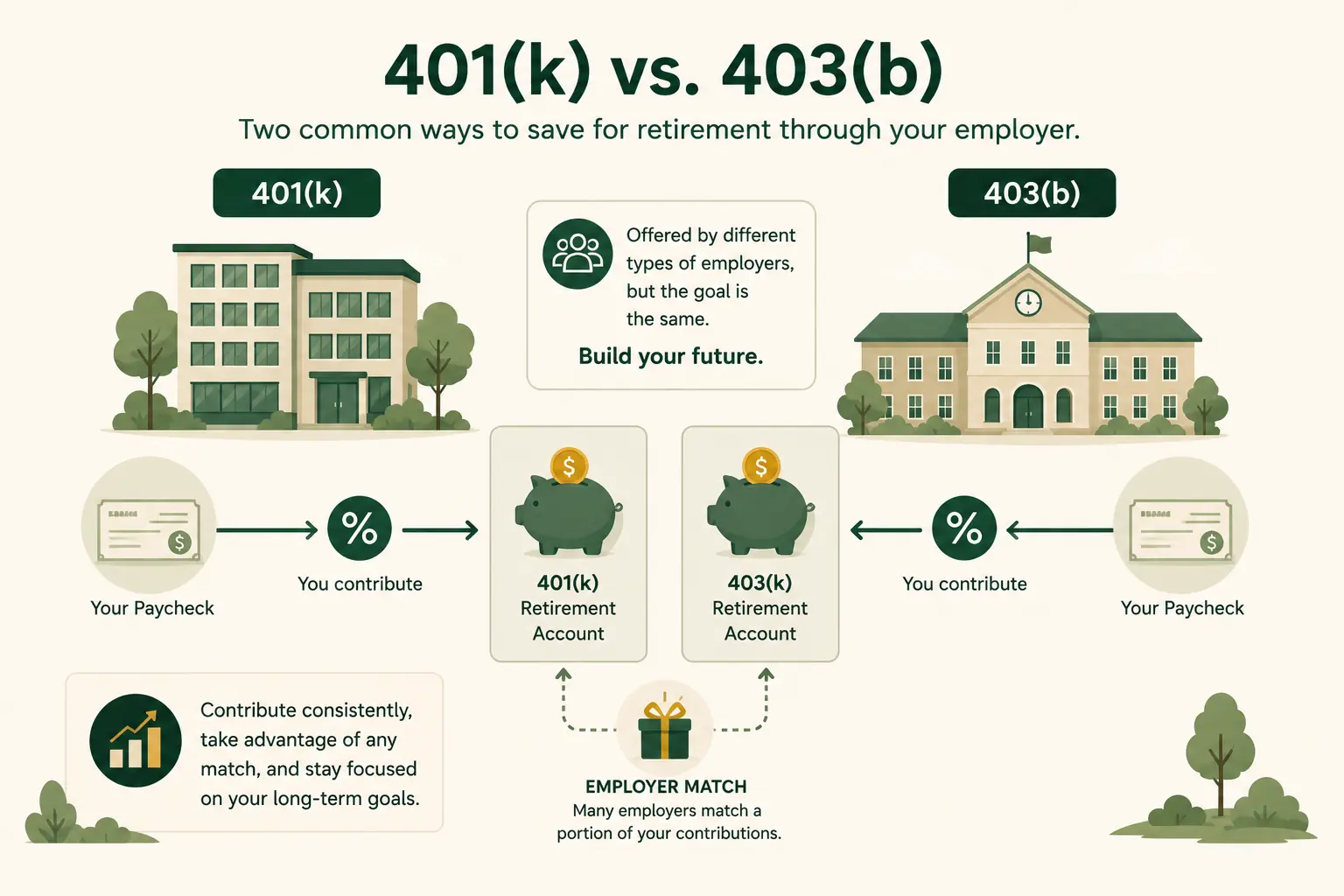
A 403b is a workplace retirement plan offered by public schools and certain tax-exempt organizations, including many nonprofits. Its purpose is the same as a 401k: you contribute part of your pay for retirement.
Your employer may also contribute, depending on the plan.
Who Usually Gets A 403b?
403b plans are common for:
- Public school teachers and administrators
- Some college and university employees
- Certain nonprofit workers (hospitals, charities, foundations)
- Some hospital or healthcare organization employees
- Some religious organization employees
Eligibility depends on the employer’s plan rules. If you work in education or for a nonprofit and your employer offers a retirement plan, it is probably a 403b rather than a 401k. The two work similarly, but 403b plans have some differences in investment options and certain legacy rules worth knowing about.
How Contributions Work
You choose how much of your pay to contribute, subject to plan and IRS limits. The money goes into your 403b account before reaching your bank (for traditional contributions).
Plans may offer:
- Traditional pre-tax contributions
- Roth contributions, if the plan allows them
- Employer matching contributions
- Employer nonelective contributions
Traditional contributions reduce your taxable income now and are taxed when you withdraw in retirement. For example, if you earn $55,000 and contribute $4,000 to a traditional 403b, you’re only taxed on $51,000 that year.
Roth contributions are taxed now, but qualified withdrawals can be tax-free, including the investment growth. That makes the Roth option especially valuable when you have decades of growth ahead.
The IRS sets annual contribution limits for 403b plans, and these change over time. Check IRS.gov for current numbers. Some long-service employees at certain organizations may also qualify for a special additional catch-up contribution.
Investment Options
403b plans may offer annuity contracts, mutual funds through custodial accounts, or other options. The menu depends on the plan.
Historically, 403b plans were dominated by insurance annuity products, which can carry higher fees and surrender charges that eat into long-term returns. Many plans now include lower-cost mutual fund or index fund options, but not all do.
Pay close attention to fees. Even a 0.5% to 1% difference in annual fees can cost you tens of thousands of dollars over a 30-year career. Ask your plan administrator for a list of expense ratios, and look for low-cost index funds if they’re available.
Compare The Match
If your employer offers a match, learn the formula. The match is part of your compensation, but you may need to contribute enough to actually receive it.
For example, an employer might match dollar-for-dollar on the first 3% of your salary. If you earn $50,000 and contribute 3% ($1,500), the employer adds another $1,500. Not contributing enough to capture the full match means leaving part of your pay on the table.
Also ask about vesting rules. Vesting is the schedule that determines when employer contributions fully belong to you. Some plans vest immediately; others spread it over several years, meaning you may lose some employer contributions if you leave early.
403b vs 401k: A Quick Comparison
| Feature | 403b | 401k |
|---|---|---|
| Who offers it | Schools, nonprofits, tax-exempt orgs | Private-sector employers |
| Contribution limit | Same (IRS limits apply equally) | Same (IRS limits apply equally) |
| Investment options | Often annuities or limited mutual funds | Mutual funds, index funds, more variety |
| Employer match | Yes, if plan offers it | Yes, if plan offers it |
| Roth option | Sometimes available | Sometimes available |
| Special catch-up rule | Some long-service employees qualify | Standard catch-up at 50+ |
Both types share the same basic purpose: tax-advantaged retirement saving through your workplace. If you have a 403b and want to compare it to other options, see What Is A 401k? for a closer look at the private-sector equivalent.
Questions To Ask
Before choosing investments, ask:
- What providers are available?
- What are the fees and expense ratios on each fund?
- Is there an employer match, and what do I need to contribute to get all of it?
- Are Roth contributions available?
- Are there surrender charges on any annuity products?
- What low-cost diversified options are available (index funds, target-date funds)?
- Does the plan have a financial advisor, and is their advice fee-only?
This is a retirement plan, so small fee differences add up enormously over time. A target-date fund at 0.1% per year and an annuity at 1.5% per year may look similar on paper, but the difference in your final balance over 30 years can be very large. See How Compound Interest Works to understand why fees matter so much over time.
What Happens When You Leave
If you leave your employer, you generally can:
- Leave the money in the 403b if your former employer allows it
- Roll it into a new employer’s 403b or 401k
- Roll it into a traditional IRA, which may give you broader investment choices
- Cash it out, but this triggers income taxes and a 10% early withdrawal penalty if you’re under 59½
Rolling over to a traditional IRA is often the most flexible option. It keeps your money growing tax-deferred and opens up a wider range of investment choices than most employer plans.
Frequently Asked Questions
Q: Is a 403b the same as a 401k?
They work similarly, both let you contribute pre-tax or Roth dollars from your paycheck for retirement. The main differences are who offers them (403b for schools and nonprofits, 401k for private employers) and that 403b plans have historically included more annuity products. The contribution limits are the same, and both offer potential employer matching.
Q: Can I contribute to a 403b and an IRA at the same time?
Yes. Contributing to a 403b doesn’t prevent you from also contributing to a traditional or Roth IRA, subject to the IRA’s own income and contribution rules. Many people contribute to their workplace plan first (at least up to the match) and then add to an IRA for more investment flexibility.
Q: What if my 403b only has expensive annuity options?
Look carefully at everything available; some plans have added lower-cost index funds in recent years. If the plan truly only offers high-fee products, contribute at least enough to capture any employer match, then put the rest of your retirement savings into an IRA where you have full control over investments and fees.
Q: How much should I contribute to my 403b?
A practical starting point is contributing at least enough to get your full employer match, since that’s effectively part of your compensation. Beyond that, try to save 10–15% of your income for retirement including any match. If that feels like a lot right now, starting at 3–5% and increasing by 1% each year builds strong habits over time.