
Checks are less common than debit cards and online payments, but they still come up for rent, deposits, school fees, gifts, and some local services. When you need to write one, filling it out correctly avoids delays and mistakes on both ends.
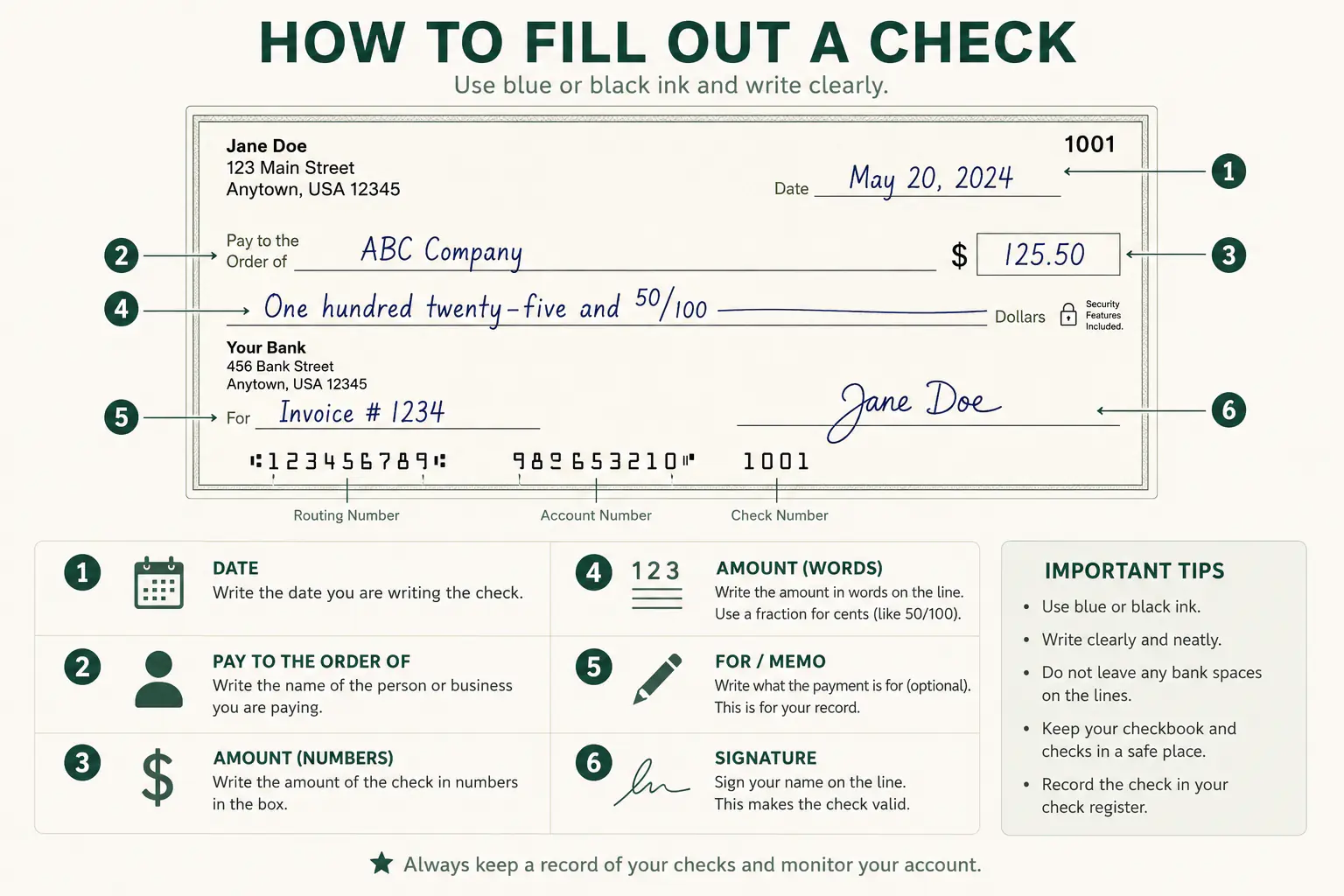
Fill Out Each Line
A typical check has six important parts:
- Date: Write the current date. In the US, month/day/year is standard (for example, 05/13/2026 or May 13, 2026).
- Pay to the order of: Write the full name of the person or business receiving the money. If you’re not sure of the exact name, ask before writing. A check made out to the wrong name can be harder to cash.
- Dollar amount box: Write the amount in numbers, like
125.50. Start as far left in the box as possible to leave no room for anyone to alter it. - Amount line: Write the amount in words, like
One hundred twenty-five and 50/100. This is the legally controlling version if the two ever conflict, so make it clear. - Memo: A short note like
June rent,security deposit, orinvoice 1042. Optional, but it helps both you and the recipient track what the payment was for. - Signature: Sign using the signature your bank has on file. An unsigned check won’t be accepted.
One firm rule: never sign a blank check. If someone finds it, they can fill in any amount and any payee.
Make The Amount Hard To Change
Use the full space on the amount line. If there’s extra room after the written amount, draw a line through it to the end. Do the same in the dollar box. Write the numbers close together and fill any remaining space with a line.
One hundred twenty-five and 50/100 -------- is safer than leaving a large blank gap. It makes it harder for someone to alter the amount after the fact.
How To Void A Check
If you make a mistake, or if you need to provide your bank account details to someone for direct deposit setup or linking a payment app, you can void a check. Write VOID in large letters across the front in permanent ink. A voided check cannot be cashed.
After voiding, keep it in your records or shred it carefully. Don’t throw a voided check in the trash intact.
Record The Check
Write down the check number, date, payee, and amount in your check register, spreadsheet, or budgeting app as soon as you write it.
A check may not leave your account for days or even weeks after you hand it over. Some people and businesses are slow to deposit. Your bank balance can look higher than what you actually have available during that window. Keeping your own record prevents you from accidentally spending money that’s already committed.
If you build a budget, treat outstanding checks as already-spent money when you calculate your available balance.
How Checks Clear
After you hand over a check, the recipient deposits or cashes it, which sends it through the banking system for processing. Most checks clear within one to three business days, though the timeline can vary. Some checks are converted to electronic payments and clear faster.
If you write a check and it hasn’t cleared after a few weeks, contact your bank to see if it’s been presented for payment. If a check is lost and never cashed, you can ask your bank to issue a stop payment. There’s typically a fee for this.
Avoid Common Mistakes
- The number amount and written amount must match. If they conflict, the written version typically controls, but it can cause a delay or rejection.
- The payee name should be legible and correct. A name that’s hard to read or wrong can cause problems at the bank.
- Don’t skip the signature. The check won’t be honored.
- Never use pencil. Pencil can be erased and altered. Use permanent ink.
- Don’t write a check if you don’t have enough money in the account to cover it. A bounced check typically means fees from your bank and possibly from the payee.
If you make a mistake, write VOID across the check and start over. Keep the voided check or shred it. Don’t just crumple it and toss it.
When You Receive A Check
Deposit it promptly. Most personal checks are valid for 180 days from the date written, though some are marked void sooner. Waiting months to deposit creates uncertainty for the person who wrote it.
To deposit, you can usually use your bank’s mobile app to take a photo, visit an ATM that accepts deposits, or go to a branch. Keep the check until the deposit is confirmed in your account.
Frequently Asked Questions
Q: What do I do if I make a mistake on a check?
Don’t try to correct it by crossing out and rewriting. Write VOID across the check and start fresh with a new one. Keep the voided check in your records or shred it.
Q: How long does it take for a check to clear?
Most checks clear within one to three business days once deposited. The bank may make part of the funds available sooner. Your bank can tell you their typical hold periods, which may vary based on deposit method and your account history.
Q: Is it safe to mail a check?
Mailing a check carries some risk of loss or theft. If you must mail one, consider using a security envelope, sending via USPS First Class with tracking, and writing “for deposit only” plus the payee’s account number in the endorsement area if you have that information. For large amounts, a money order or cashier’s check may be safer, or arrange an electronic payment instead.
Q: What is the routing number and account number on a check?
At the bottom of a check you’ll find two sets of numbers. The nine-digit routing number identifies your bank. The account number identifies your specific account. These are needed for direct deposit, electronic transfers, and bill pay. Don’t share them with anyone you don’t trust. They can be used to initiate electronic debits from your account.
Learn More
- Consumer Financial Protection Bureau: Bank accounts and services
- FDIC: How checking accounts work