
A budget is just a plan for your money before it leaves your hands. Without one, it tends to disappear without a clear reason. With one, you can make actual choices about what gets paid, what gets saved, and what’s left over.
Building one doesn’t require complicated software or perfect numbers. You need three things: your income, your fixed obligations, and a rough sense of where the rest goes.
Step 1: Start With Take-Home Pay
Use your monthly take-home pay, not your gross salary. Take-home pay is what actually lands in your account after taxes and deductions. Budgeting from your gross salary builds a plan that will never match reality.
If your income varies from week to week, average the last two or three months and use the lower end. A budget built on an optimistic income number fails every slow month.
If you freelance or do gig work, estimate conservatively and adjust as months vary. Underestimating income and overestimating expenses is much safer than the reverse.
Not sure what take-home pay means? See Gross Pay vs Take-Home Pay for a breakdown of what comes out of your paycheck before you see it.
Step 2: List Fixed Expenses
Fixed expenses are bills that are the same every month and non-negotiable.
Common examples:
- Rent or mortgage
- Car payment
- Insurance premiums (auto, renters, health)
- Minimum debt payments
- Internet
- Phone
- Subscriptions that are essential and would be hard to cancel
Write down every fixed expense and its due date, then total them.
If fixed expenses plus taxes are already eating most of your income, that is important to know. There’s not much room left, and something may need to change over time: a cheaper place to live, a refinanced loan, or more income.
Step 3: Estimate Variable Expenses
Variable expenses change from month to month but are predictable by category.
Common examples:
- Groceries
- Gas or transit
- Utilities (when not fixed)
- Dining out
- Entertainment and streaming
- Clothing
- Household supplies
- Personal care
Look at last month’s bank or card statements. Add up what you actually spent in each category, not what you wish you spent. That real number is your starting estimate. Most people are surprised by what they find, especially in food, dining, and small recurring purchases.
Step 4: Set A Savings Target
Before the budget is finalized, decide how much to save.
Saving works better when it comes before discretionary spending, not after. Treating savings like a bill that gets paid first (sometimes called “paying yourself first”) makes it far more likely to actually happen, rather than ending up with nothing left at month’s end.
Start with something realistic. Even $25 or $50 per paycheck can grow into meaningful savings over time. If you’re building an emergency fund, that is a natural first target.
Step 5: Add It Up And Adjust
Add:
- Fixed expenses
- Variable expense estimates
- Savings target
If the total is less than your take-home pay, the difference is your discretionary room. That money can go to extras, additional savings, or paying down debt faster.
If the total is more than your take-home pay, something has to change. That usually means cutting variable spending, renegotiating bills, dropping subscriptions, or increasing income.
A budget that doesn’t balance on paper won’t balance in real life. The math has to work before the month starts.
The 50/30/20 Framework
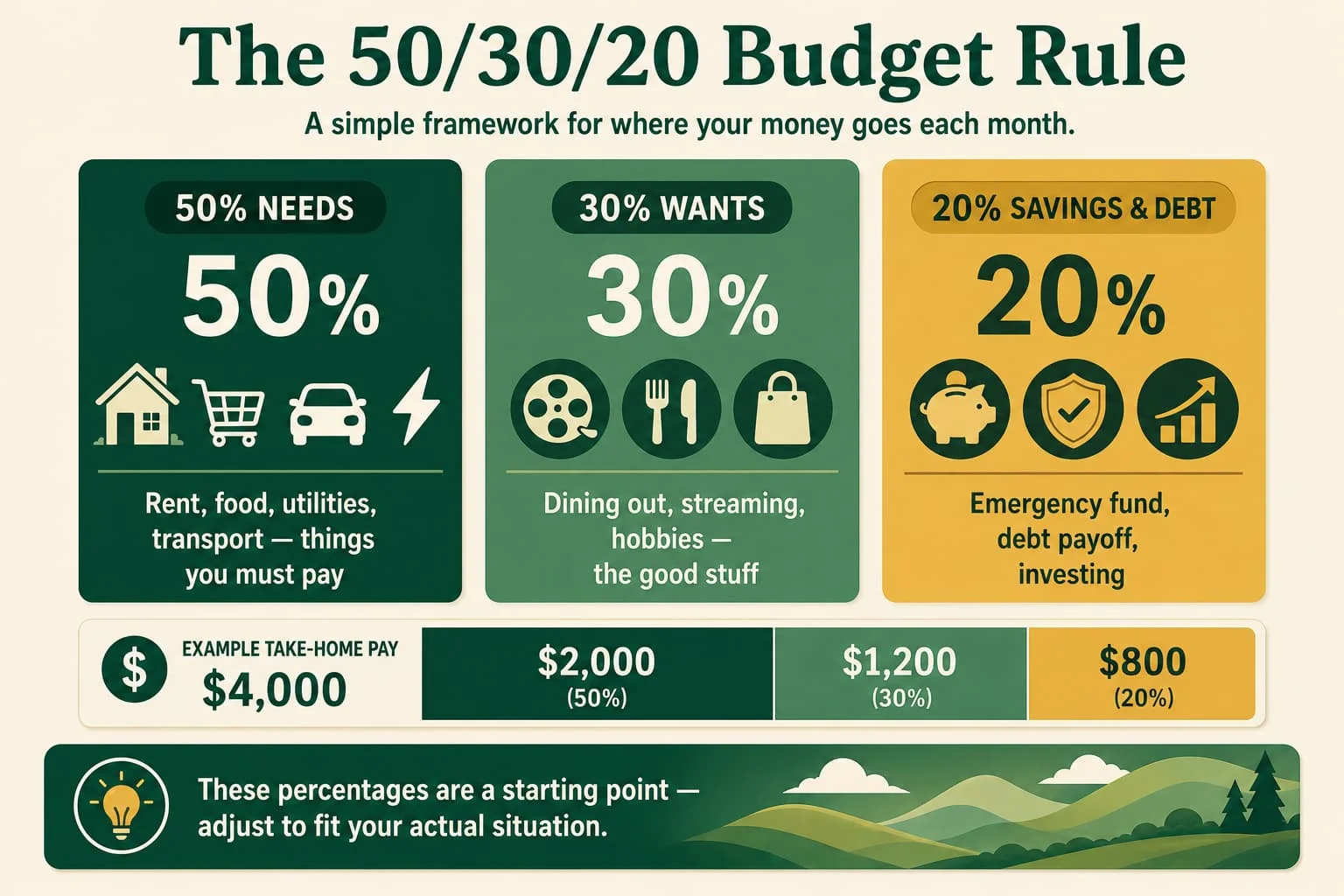
One popular approach divides take-home pay into three broad buckets:
| Bucket | Percentage | What Goes Here |
|---|---|---|
| Needs | 50% | Rent, utilities, groceries, transportation, minimum debt payments |
| Wants | 30% | Dining out, entertainment, travel, hobbies, subscriptions |
| Savings and debt payoff | 20% | Emergency fund, retirement, extra debt payments |
This framework is a starting point, not a rule. High rent in an expensive city, large debt payments, or a lower income can make the 50% needs bucket impossible to hit. Adjust the proportions to your real situation. The goal is a plan you can actually follow, not one that looks clean on paper.
Zero-Based Budgeting
Another approach assigns every dollar a job before the month starts. Income minus all expenses, savings, and debt payments equals zero.
This doesn’t mean spending everything. Every dollar is assigned somewhere, including dollars going to savings, an emergency buffer, or a sinking fund for a future expense.
Zero-based budgets take more tracking but can feel more deliberate, especially if money keeps disappearing each month without a clear reason.
Making It Work Month To Month
Pick a review time once a month. Even 15 minutes. Compare what you planned to what actually happened, then adjust the next month’s plan based on what you learned.
Common early problems:
- Forgetting irregular expenses like car insurance due quarterly or annual subscriptions
- Underestimating food and gas
- Treating credit card minimums as the full payment instead of a floor
- Not planning for one-time costs like gifts, car registration, or school fees
A budget isn’t meant to be perfect the first month. It improves each month you run it. The goal is a clearer picture of your financial life so you make decisions on purpose rather than by accident.
Frequently Asked Questions
Q: What is the easiest budgeting method for beginners?
The 50/30/20 method is often the easiest starting point because it doesn’t require tracking every dollar, just three broad buckets. If you want more control or keep overspending in specific areas, a more detailed category-based budget or zero-based approach can help. The right method is the one you’ll actually use.
Q: How do I budget when my income changes every month?
Use the lowest paycheck from the last few months as your baseline income. Build your budget around that floor. In higher-income months, put the extra toward savings, debt payoff, or the next month’s buffer. Try not to build a lifestyle that only works in the good months.
Q: Should I budget by paycheck or by month?
Most budgets work on a monthly basis because most bills recur monthly. If you’re paid biweekly, it can help to think in four-week cycles. Some people budget paycheck-by-paycheck and assign each one to specific bills and spending. Either approach works. Pick the one that matches how you naturally think about money.
Q: What if I blow my budget one month?
It happens to almost everyone. The goal is not perfection. It’s a pattern you can live with over time. Look at what caused the overage (a genuine emergency, a predictable expense you forgot to include, or impulse spending), adjust the next month’s plan, and keep going. One rough month does not mean the system failed.
Learn More
- Consumer Financial Protection Bureau: Make a budget
- Consumer Financial Protection Bureau: How to save for emergencies and the future
- FDIC: Money smart financial education