
A house down payment is only one part of the cash you need to buy a home. You also need closing costs, moving money, setup costs, and an emergency cushion for the things that break after you move in.
That’s why the best down payment isn’t always “as much as possible.” It’s the amount that lets you buy safely without draining every dollar you have.
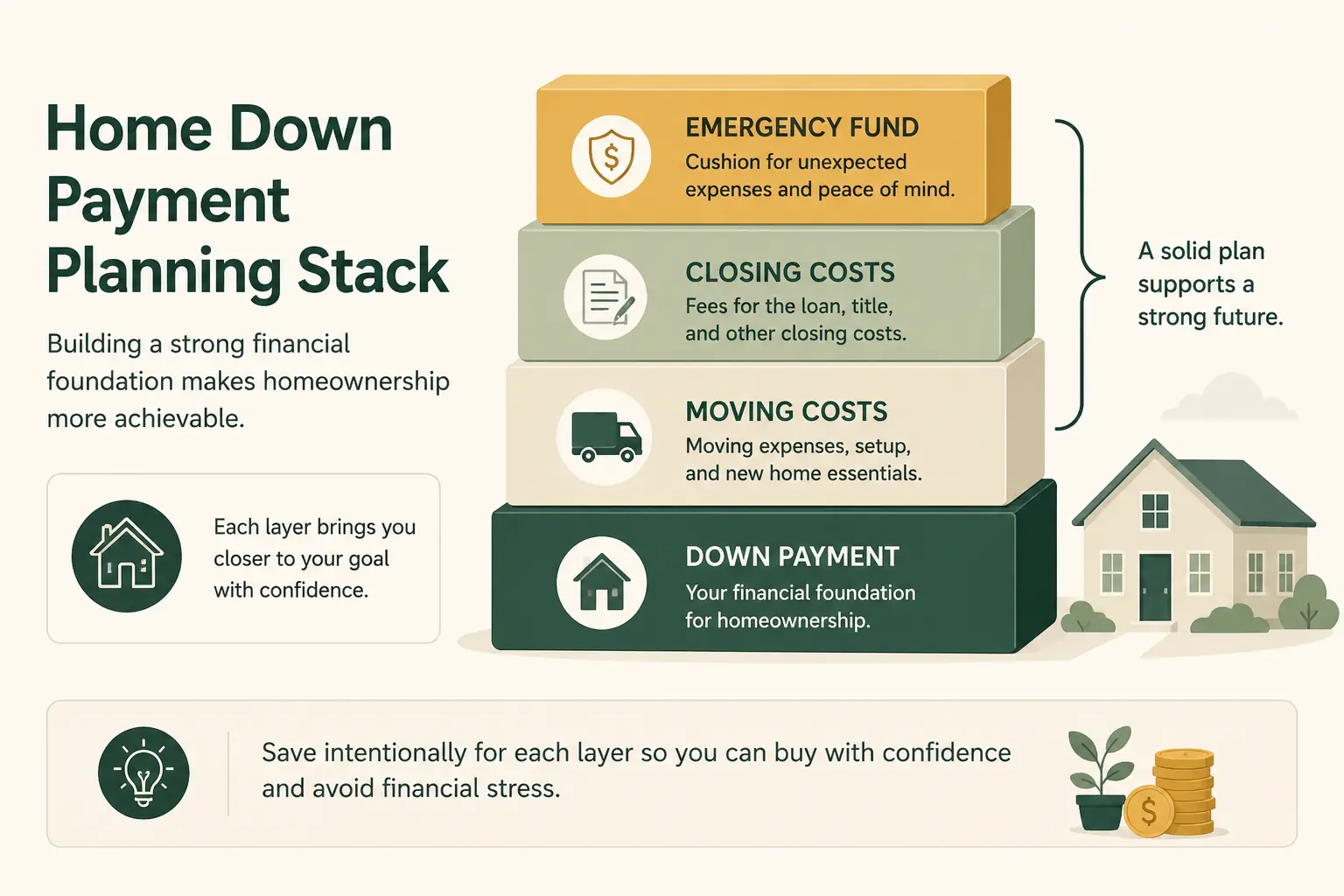
Start With Available Cash
Add up money that’s actually available for buying the home. Then subtract what you shouldn’t spend.
Set aside:
- Emergency savings (aim to keep 3 to 6 months of expenses untouched even after closing)
- Moving costs (truck rental, movers, packing supplies)
- Utility setup costs and deposits
- Basic furniture or appliances you’ll need immediately
- Money for immediate maintenance or repairs
- Any other short-term obligations coming up
The amount left is closer to your real maximum cash available for closing.
Remember Closing Costs
Closing costs are separate from the down payment. They can include:
- Lender origination fees
- Title insurance and title search fees
- Appraisal fee
- Home inspection fee
- Prepaid property taxes (often 2–3 months upfront)
- Prepaid homeowners insurance
- Prepaid mortgage interest
- Recording fees and transfer taxes
The Consumer Financial Protection Bureau notes that closing costs often range from 2% to 5% of the home purchase price, not counting the down payment.
On a $300,000 home, that is $6,000 to $15,000 just in closing costs, before the down payment. If you only save for the down payment, closing costs can catch you off guard at the worst possible time.
Why 20% Gets So Much Attention
Putting 20% down can have real advantages:
- It may get you a lower interest rate on many conventional loans
- It can help you avoid private mortgage insurance (PMI), an extra monthly fee that protects the lender (not you) if you default
- You start with more equity, which matters if home values fall
But 20% isn’t always required. Several loan programs allow lower down payments:
- FHA loans: As low as 3.5% down (requires mortgage insurance for the life of the loan in many cases)
- Conventional loans: As low as 3–5% down (PMI required until you reach 20% equity)
- VA loans: 0% down for eligible veterans and active-duty service members
- USDA loans: 0% down for eligible rural and some suburban properties
The trade-off is that a smaller down payment means borrowing more, paying more interest, and paying mortgage insurance until you build equity.
What Is PMI And How Much Does It Cost?
Private mortgage insurance (PMI) is a monthly fee added to your mortgage payment when your down payment is less than 20% on a conventional loan.
PMI typically costs between 0.5% and 1.5% of the loan amount per year. On a $280,000 loan, that is roughly $117 to $350 per month added to your payment, until you reach 20% equity in the home.
PMI isn’t permanent. Once your loan balance drops to 80% of the home’s original value, you can typically request cancellation. It cancels automatically at 78% under federal law.
Down Payment Tiers And What They Mean
| Down Payment | PMI Required? | Notes |
|---|---|---|
| Less than 3% | Usually | Few conventional programs go this low; FHA may be better |
| 3–5% | Yes | Many first-time buyer programs available |
| 10% | Yes (until 20% equity) | Lower monthly PMI cost; more lender confidence |
| 20% | No | No PMI; best rates; requires significant savings |
| More than 20% | No | Extra equity upfront; may be worth considering in some cases |
Lenders may price loans differently at different down payment levels. Sometimes going from 8% to 10%, or from 15% to 20%, can shift the interest rate tier and meaningfully reduce total cost. Ask lenders to show you options at different down payment amounts so you can compare monthly payment, interest rate, mortgage insurance, and closing costs side by side.
Do Not Buy With No Cushion
New homeowners often discover immediate costs that renters never deal with:
- Locks replaced for security
- Basic tools for maintenance
- Lawn equipment
- Appliances that need replacing
- Small repairs not caught in inspection
- Furniture for new rooms
- Higher utility bills (larger space, older systems)
- Unexpected maintenance surprises in the first year
If the down payment leaves you with no emergency money, the first repair lands on a credit card. Most financial advisors suggest keeping at least 1% of the home’s value available for annual maintenance. On a $300,000 home, that is $3,000 per year.
A Simple Planning Formula
Try this:
- Estimate home price based on what’s realistic in your target area.
- Estimate closing costs (use 2–5% of home price as a starting estimate).
- Set aside emergency savings you won’t touch.
- Set aside moving and immediate setup money.
- Research down payment assistance programs in your state; many first-time buyers qualify.
- Compare down payment options using an online mortgage calculator.
- Choose the option that leaves the total monthly payment affordable and keeps cash reserves intact.
The goal isn’t just to get the keys. The goal is to still be financially stable after getting the keys.
Renting While You Save: Is It Worth Waiting?
Saving for a larger down payment takes time. While you save, rent prices and home prices may change. There’s no universal answer about whether to buy sooner with less down or wait to save more.
What matters is whether the monthly payment at closing is manageable, not just barely possible, but genuinely affordable with room for savings and surprises. If you’re currently renting, see How Much Rent Can I Afford? for help making sure your current rent isn’t crowding out your savings goals.
Frequently Asked Questions
Q: How much should I put down on a house?
It depends on your loan type, income stability, and how much you’ve saved. Twenty percent is often cited because it avoids PMI and gets better rates, but many first-time buyers put down 3–10% and still buy successfully. The more important question is whether you can afford the total monthly payment, including mortgage, taxes, insurance, and maintenance, while keeping an emergency fund intact.
Q: What is PMI and can I avoid it?
PMI (private mortgage insurance) is a monthly fee added when your down payment is less than 20% on a conventional loan. You can avoid it by putting down 20% or more, or by using certain loan programs like VA loans (if you’re eligible). PMI isn’t permanent: you can ask to cancel it once you have 20% equity in the home, and it ends automatically at 22%.
Q: Are there programs to help with the down payment?
Yes. Many states and localities have first-time homebuyer programs offering down payment assistance through grants or low-interest second mortgages. HUD’s website has a directory of approved housing counseling agencies and assistance programs by state. Federal programs like FHA, VA, and USDA loans also offer lower minimum down payment requirements.
Q: Should I drain my savings to make a bigger down payment?
Generally no. A bigger down payment reduces your loan and monthly costs, but if it leaves you with no cash cushion, you’re one car repair or roof leak away from financial stress. Most advisors suggest keeping 3–6 months of expenses in savings even after closing, separate from any home repair fund.
Learn More
- Consumer Financial Protection Bureau: Determine your down payment
- Consumer Financial Protection Bureau: What costs come with taking out a mortgage?
- HUD: Find a housing counselor near you
- HUD: First-time homebuyers guide