
A car down payment is money you pay upfront toward the purchase price. The more you put down, the less you need to borrow. That can lower the monthly payment, reduce interest, and make the loan less risky.
There’s no perfect down payment for every buyer. The right number depends on the car price, loan terms, interest rate, emergency savings, and how stable your income is.
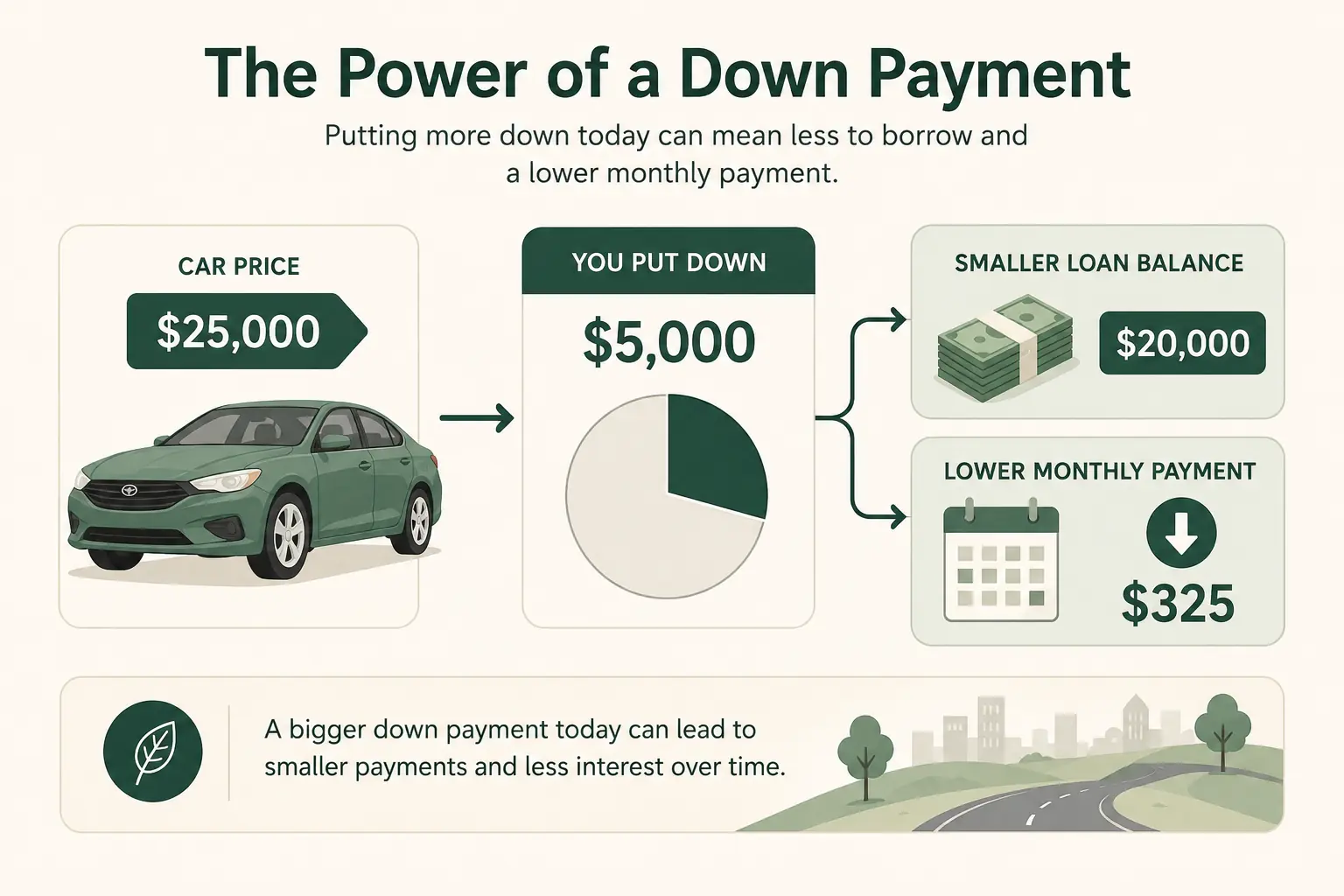
Why A Down Payment Helps
A down payment reduces the loan principal. If the car costs $18,000 and you put down $3,000, you’re financing $15,000 instead of $18,000.
Borrowing less can mean:
- Lower monthly payments
- Less total interest paid over the life of the loan
- A shorter path to paying the loan off
- Less chance of being “upside down” (owing more than the car is worth)
- More lender confidence, which can mean a better interest rate in some cases
Being upside down on a car loan is a real risk. New cars lose roughly 15–25% of their value in the first year. If you put nothing down on a $22,000 car and it depreciates $4,000 in a year, you may owe more than it’s worth for a long time, which creates problems if you need to sell, trade in, or if the car is totaled in an accident.
Down Payment Targets By Situation
There’s no single right answer, but here are common guidelines:
| Situation | Suggested Down Payment |
|---|---|
| New car | 20% or more |
| Used car | 10% or more |
| Credit is thin or rebuilding | As much as possible |
| Loan term is 60+ months | More down reduces risk of going upside down |
| Car is heavily depreciating model | More down protects against quick value loss |
| Emergency savings are low | Keep more cash; buy cheaper car instead |
If saving 10–20% means waiting 6–12 months, consider whether buying a less expensive car sooner might be a better option than a more expensive car with no down payment.
Watch The Total Loan, Not Just The Payment
Dealers and lenders may focus on the monthly payment. Monthly payment matters, but it can hide the real cost if the loan term is stretched too long.
Before agreeing, compare these numbers in writing:
- Car price (not the sticker, the negotiated price)
- Down payment and trade-in value
- Taxes, fees, and add-ons
- Interest rate (APR)
- Loan term in months
- Monthly payment
- Total interest paid over the life of the loan
- Total amount paid (price + interest + fees)
A $400/month payment sounds manageable, but on a 72-month loan at 8%, you could pay several thousand dollars more in interest than on a 48-month loan. For more on how APR works, see What Is APR?
Do Not Empty Your Emergency Fund
A larger down payment is useful, but not if it leaves you with no cash for repairs, insurance, registration, or a missed paycheck.
Cars create ongoing costs that start immediately:
- Insurance (required before you drive off the lot)
- Registration and title fees
- Maintenance (oil changes, tires, brakes)
- Repairs, especially on used vehicles
- Fuel
- Emergency savings
Buying the car is only the first cost. If you drain your emergency fund to make a larger down payment and then need a repair a month later, you may end up back in debt to cover it. See What Is An Emergency Fund? for guidance on how much to keep in reserve.
Trade-Ins Can Be Complicated
If you trade in a car you still owe money on, the old loan balance matters. If the trade-in is worth less than the loan, that negative equity may get rolled into the new loan.
For example: your car is worth $8,000 but you owe $11,000. That $3,000 gap may be added to your new loan, making it $3,000 larger before you even start. This can raise your monthly payment and put you upside down on the new loan immediately.
Ask for all numbers in writing and make sure you understand exactly how the trade-in value, old loan payoff, and down payment are being applied.
A Practical Target
If you can save 10% to 20% of the car price without draining emergency savings, that is generally a strong starting point.
- On a $15,000 used car, 10% = $1,500 and 20% = $3,000
- On a $25,000 new car, 10% = $2,500 and 20% = $5,000
If saving that much isn’t possible right now, consider:
- Buying a less expensive car
- Shortening the loan term to reduce interest cost
- Waiting a few more months to save more
- Looking at certified pre-owned vehicles with lower price tags
The down payment should make the loan safer and more manageable, not leave the rest of your financial life fragile.
Frequently Asked Questions
Q: Is it better to put more down or keep the cash?
It depends on your interest rate and what you’d do with the cash. If your car loan interest rate is 8% and your savings account earns 4.5%, putting more down saves you more in interest than you earn. But if putting more down would empty your emergency fund, keeping the cash is usually wiser. A small loan is only helpful if you can keep up with payments when something unexpected happens.
Q: Do I need a down payment to get a car loan?
Not always. Some lenders and dealerships offer zero-down loans. But no-down-payment financing usually means a higher loan balance, possibly a higher interest rate, and a much greater risk of being upside down quickly, especially on a new car that depreciates fast.
Q: How does my credit score affect my car loan?
Your credit score affects the interest rate you’re offered. A higher score typically means a lower rate, which reduces total cost significantly over the life of a loan. If your credit is thin or low, you may face higher rates, making a larger down payment even more important to offset the cost. See How To Build Credit From Scratch if you’re working on building your credit history.
Q: What is “upside down” on a car loan?
Being upside down means you owe more on the loan than the car is currently worth. This is a problem if you need to sell the car, trade it in, or if it gets totaled in an accident, because the insurance payout may not cover what you owe. New cars depreciate quickly, so a small or no down payment makes this more likely in the first year or two.
Learn More
- Consumer Financial Protection Bureau: How does a down payment affect my auto loan?
- Consumer Financial Protection Bureau: Auto loan guide
- FTC: Buying a new car
- FTC: Buying a used car