
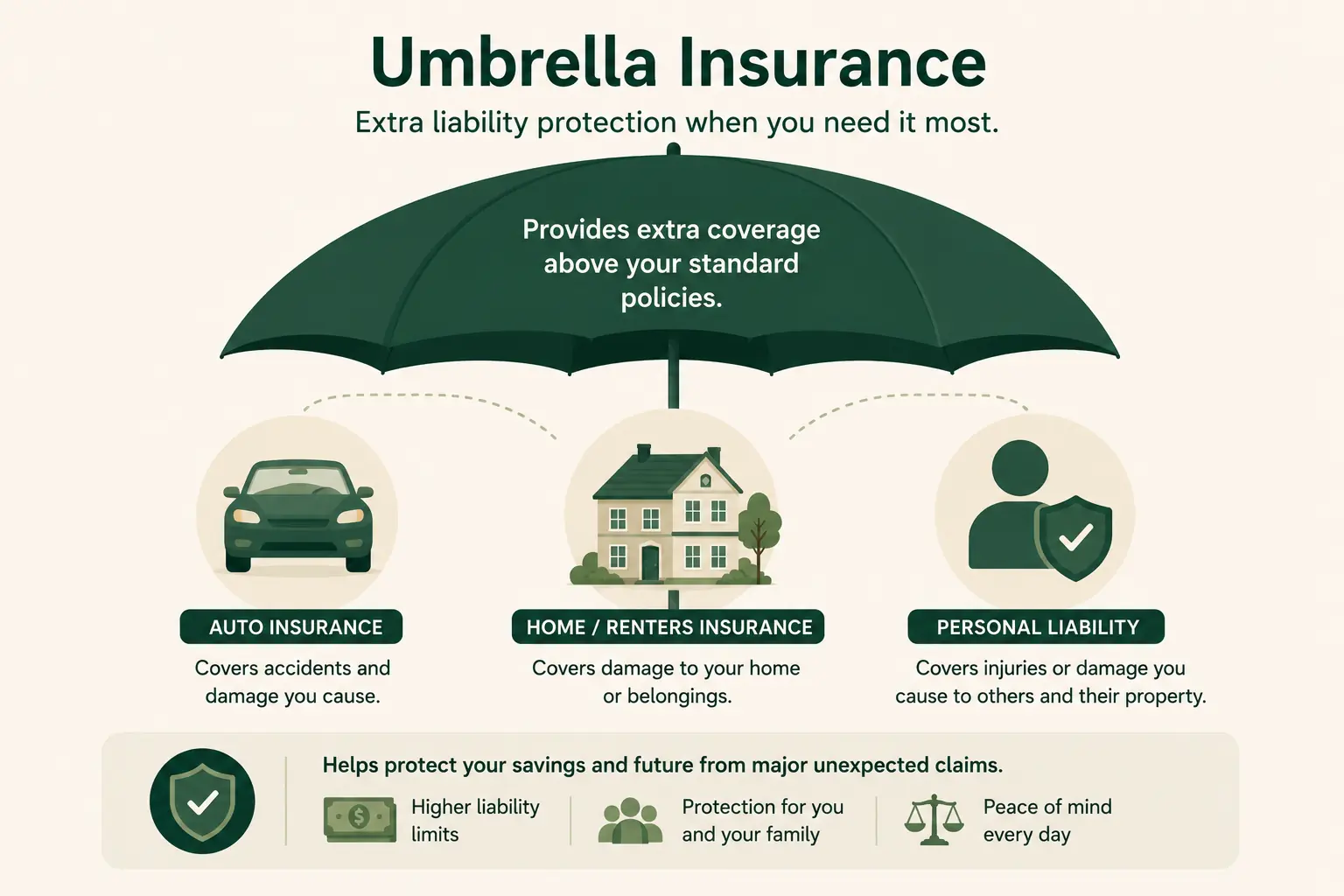
Umbrella insurance is extra liability coverage that sits on top of your existing policies, like auto, homeowners, or renters insurance. It’s there for when a covered claim gets big enough to exceed your base policy limits.
It doesn’t replace your regular insurance. It works after underlying coverage is used up, assuming the claim is covered.
What Liability Means
Liability coverage helps pay costs when you’re legally responsible for injuring someone or damaging their property.
Examples might include:
- A serious car crash where the injured party’s medical bills exceed your auto liability limits
- A guest injured at your home or apartment
- A lawsuit related to defamation or invasion of privacy
- Your dog biting someone
- An accident involving a rental property you own
Coverage depends on the specific policy. Not every policy covers every scenario, so reading the terms carefully matters.
How Umbrella Insurance Works
Think of it as a stack. Your auto policy has a liability limit, say $300,000. Your homeowners or renters policy has one too. An umbrella policy adds a layer on top, often in increments of $1 million.
If a covered claim exceeds your base liability limit, the umbrella picks up from there up to its own limit. Without umbrella coverage, anything above your base policy limits would typically come out of your own assets or future income.
Umbrella policies generally require you to carry minimum liability limits on the underlying policies first. The insurer wants that first line of protection in place before the umbrella activates. If you increase your renters insurance or car insurance liability limits, umbrella coverage becomes even more meaningful.
Why Umbrella Coverage Exists
Standard auto or homeowners liability limits may not be enough for a major claim. If damages exceed your limits, your savings, home equity, or future income could be on the line.
Situations where underlying limits can fall short:
- A multi-car accident with multiple serious injuries
- A house guest with a significant, long-term injury
- A lawsuit that includes lost wages and pain and suffering
- A claim that drags through the courts and generates substantial legal defense costs
Umbrella insurance is designed to cover those gaps.
What It May Not Cover
Umbrella insurance has real exclusions.
It often won’t cover:
- Your own injuries or property damage
- Business activities (a separate business policy may be needed)
- Intentional acts
- Certain vehicles like aircraft or some watercraft
- Professional liability or errors and omissions
- Claims arising outside the U.S. in some policies
Read the policy carefully and ask your insurer about specific exclusions. They vary.
Who Might Consider It?
Umbrella insurance is probably worth a look if you:
- Own a home or rental property
- Have savings, investments, or other assets worth protecting
- Have teenage or inexperienced drivers on your policy
- Host guests frequently
- Have a dog or other animals
- Have meaningful future income to protect from wage garnishment
- Already carry high underlying liability limits and want additional protection
Umbrella policies can be relatively affordable for the coverage amount, often a few hundred dollars a year for $1 million in additional protection. The exact cost depends on your situation and insurer.
Most insurers will require minimum liability limits on your underlying auto, homeowners, or renters policies before you can buy umbrella coverage.
Real-World Scenarios: When Umbrella Coverage Matters
Abstract talk about “excess liability” can be hard to picture. These scenarios show what happens when underlying limits run out.
Scenario 1, Serious car accident: You’re at fault in an accident that seriously injures two people. Medical treatment, rehabilitation, and lost wages for both total $480,000. Your auto liability limit is $300,000. Without umbrella, you’re personally responsible for $180,000. With a $1 million umbrella, that remainder is covered.
Scenario 2, Dog bite: Your dog bites a visitor who requires surgery and sues for $420,000 in medical expenses, lost wages, and pain and suffering. Your homeowners policy has a $300,000 liability limit. Without umbrella, $120,000 comes from you. With umbrella, fully covered.
Scenario 3, Teen driver: Your 17-year-old causes an accident in the family car, injuring three passengers. Total damages: $400,000. Your auto policy covers $300,000. The umbrella covers the remaining $100,000.
Scenario 4, Social media defamation claim: You make statements online that someone claims are false and damaging to their reputation. They sue for $200,000. Some umbrella policies include personal liability for defamation, libel, and slander, while standard auto and homeowners policies often don’t cover this at all. Check the specific policy language.
These aren’t rare outcomes. Personal injury lawsuits regularly exceed standard policy limits, and legal defense costs alone can be substantial even in cases you ultimately win.
What Umbrella Insurance Typically Requires
Before selling umbrella coverage, most insurers require minimum liability limits on your underlying policies, typically:
- Auto insurance: at least $250,000 per person / $500,000 per accident bodily injury liability, and $100,000 property damage
- Homeowners or renters insurance: at least $300,000 liability
Requirements vary by insurer. If your current limits are below those thresholds, you may need to increase them first, which will raise your base premiums somewhat.
Many insurers offer umbrella policies bundled with existing auto and homeowners coverage, which can simplify the process and may reduce costs. Starting with the insurer that already holds your other policies is a reasonable approach.
Umbrella Coverage and Net Worth
A common rule of thumb is that umbrella coverage should be at least equal to your net worth. Someone with $500,000 in assets (home equity, retirement accounts, savings) could potentially lose all of it to a large judgment if their base policies are exhausted and there’s no umbrella.
As net worth grows, the case for umbrella coverage gets clearer. Someone with $50,000 in assets has less to protect. Someone with $300,000 in home equity and $400,000 in retirement savings has significant exposure.
Future income is part of the picture too. A court can garnish wages to satisfy a judgment. A large liability judgment doesn’t disappear just because you don’t have the assets today.
Frequently Asked Questions
Q: How much umbrella insurance do I need?
A common starting point is $1 million, which is also the most common minimum policy amount available. Whether you need more depends on your assets, income, and how much liability exposure you carry. A general rule of thumb: coverage should at least equal your net worth, so a major lawsuit doesn’t wipe out what you’ve built. Higher limits are available and often don’t cost much more.
Q: Does umbrella insurance cover lawsuits?
It can cover legal defense costs and damages for covered claims, up to policy limits. That includes attorney fees. This is one of the more valuable aspects of umbrella coverage since lawsuits are expensive to defend even when you’re not at fault, and legal costs add up quickly regardless of the outcome.
Q: Do I need umbrella insurance if I’m renting?
Possibly. Renters still have real liability exposure, someone injured in your apartment, a car accident that exceeds your auto policy limits, and so on. If you have savings or future income worth protecting, umbrella coverage is worth pricing out. It’s relatively affordable and layers on top of your renters insurance liability coverage.
Q: Can I buy umbrella insurance without homeowners insurance?
Umbrella policies typically require you to carry underlying auto or homeowners/renters liability coverage at minimum limits first. Most insurers want that first layer in place. You generally can’t buy umbrella coverage as a standalone policy without those underlying policies. Check with specific insurers for their exact requirements.
Learn More
- NAIC: Umbrella insurance
- NAIC: Consumer insurance resources